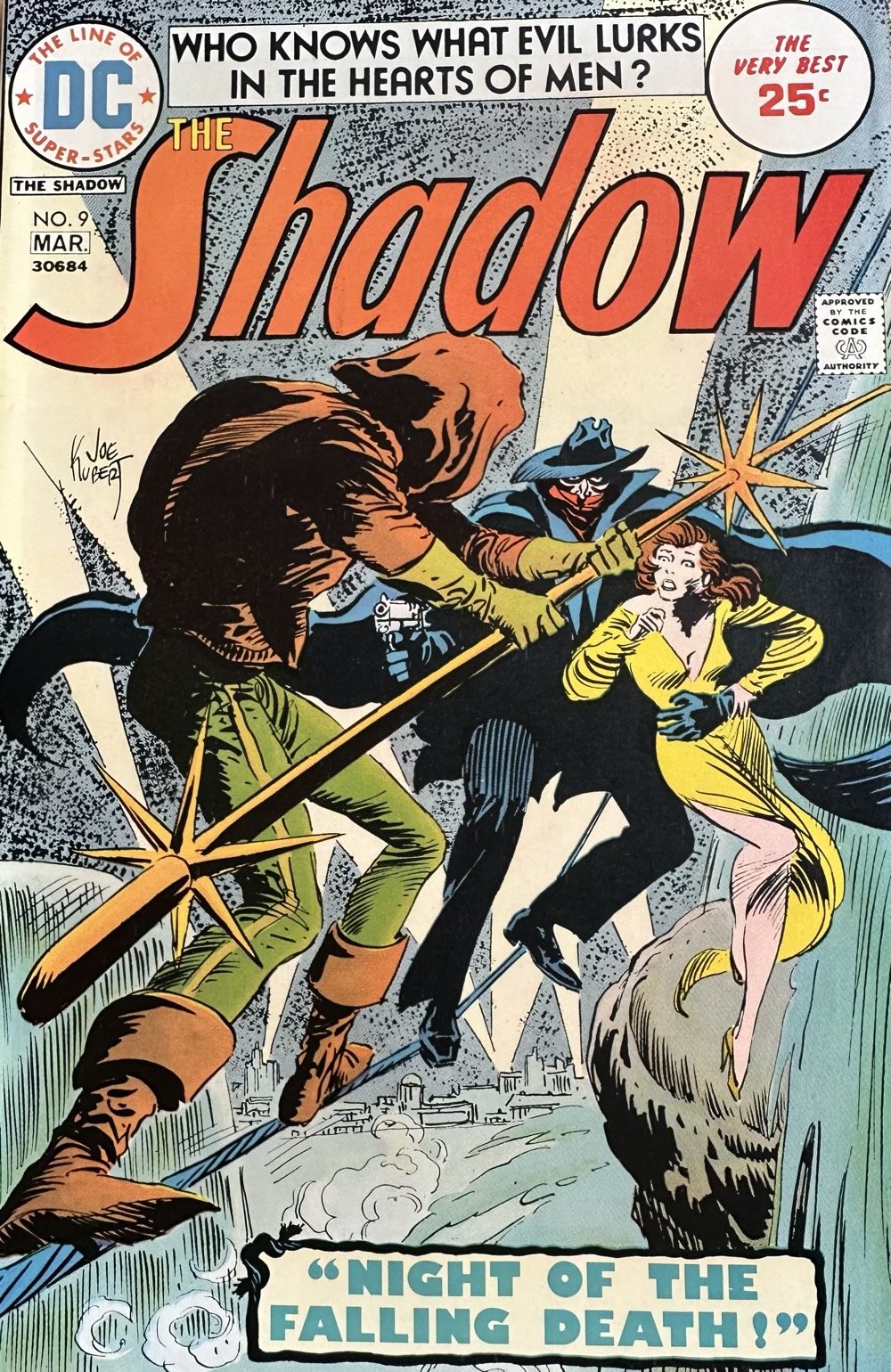
THE SHADOW SCRAPBOOK (1979)

The latest addition to the collection, a first edition of Walter Gibson’s THE SHADOW SCRAPBOOK. Here’s the title page, signed by Gibson:

Gibson, on his writing days (which produced 282 +/- of the 325 SHADOW issues (plus comics) that Gibson, as Grant, penned):

I was turning out first drafts at a rate of four pages an hour, each page running over 250 words. That meant a little over thirty pages in an eight-hour day, or better than 8,000 words. At that rate, I could finish a 60,000-word story in less than eight days, but I never wrote one that mechanically. Usually I was slow in warming up or took a few too many breaks, so I felt lucky if I got beyond twenty pages on the first or second day. But once the story was rolling, & didn't care about the hours. With a few breaks, _ would work up to ten or even twelve hours a day, hitting as high as forty or even fifty pages.

I generally started around nine o'clock on the morning of the first day but seldom worked steadily until five or six o'clock. I might take the afternoon off and finish my stint in the evening; or go out in the evening and put in a few hours after I came in around midnight. In the latter case I wouldn't begin my second "day" until about noon, which would push the third "day" even further ahead. A few more hours of extra work would push the following "day" still further on, and there were times when I slept so late that I didn't start until early evening but kept going until the following dawn.

The whole book is available via The Internet Archive; stoked to have a physical edition –the signature makes it even more wonderful. Will add more from it as I peruse and read.

re/visit :: CATCHING THE BIG FISH (Lynch, 2006)

Though I've endlessly perused Lynch's ode to TM-infused creativity in the 15+years since I last read it, this was my first time re-reading it in its totality or, rather, having David Lynch read it to me while I drove in circles on a lawnmower (THE STRAIGHT STORY part of my days) which gave it a whole new life.

Apparently my fragmentary thinking – and my efforts to stay there – has/have been around for a long time:

It would be great if the entire film came all at once. But it comes, for me, in fragments. That first fragment is like the Rosetta Stone. It's the piece of the puzzle that indicates the rest. It's a hopeful puzzle piece...

You fall in love with the first idea, that tiny little piece. And once you've got it, the rest will come in time.

(These are my perpetual efforts to remember that final sentence.)

Recommended, wholly, just as it was 17 years ago – and especially worthwhile as an audio book, like Rubin's THE CREATIVE ACT: there's something about having both Lynch and Rubin speaking to you, whispering in your lone ear, lying in a field. Essential to the creative library.

Other note: I always have to type David Lynch twice, as I invariably type David Lunch the first time.

“… like a swiss watch”

Before the pandemic, Schrader had a standard routine when beginning a screenplay. He'd tell the germ of a story out loud; if the tale held a small group's attention for ten minutes, he'd go home, write it down with more detail, and run through the process again. He'd get up to twenty minutes, then forty-five. If the story still kept people interested, he'd set it all down on a legal pad, devoting a handful of words and a time stamp to every scene he envisioned. These final outlines are dense, uniform--almost without exception, they fit onto one page--and visually striking, like mathematical proofs. "Paul's writing is all about concision," Scorsese told me. "Everything counts, there's not a word out of place, and all the parts work together like a Swiss watch."

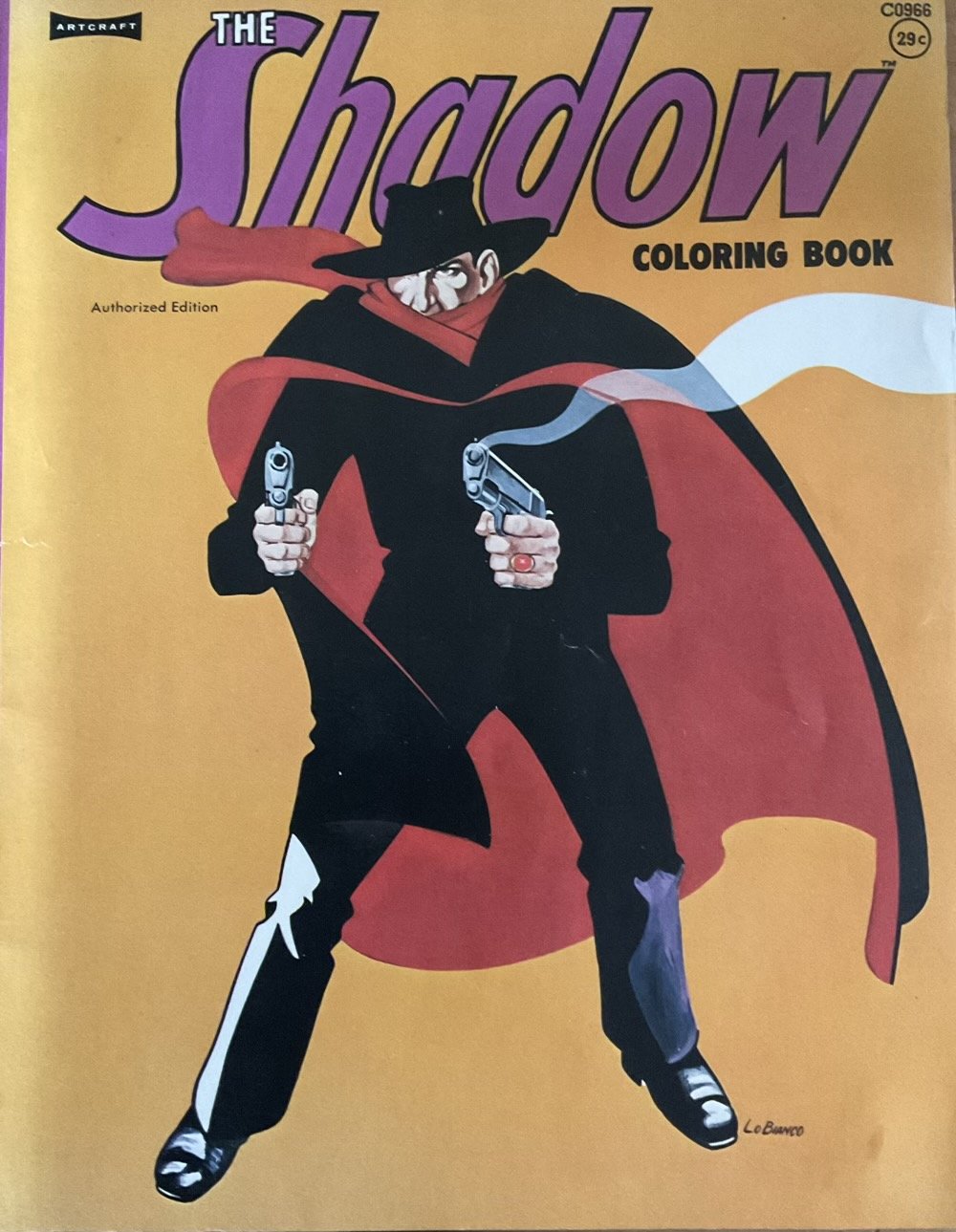
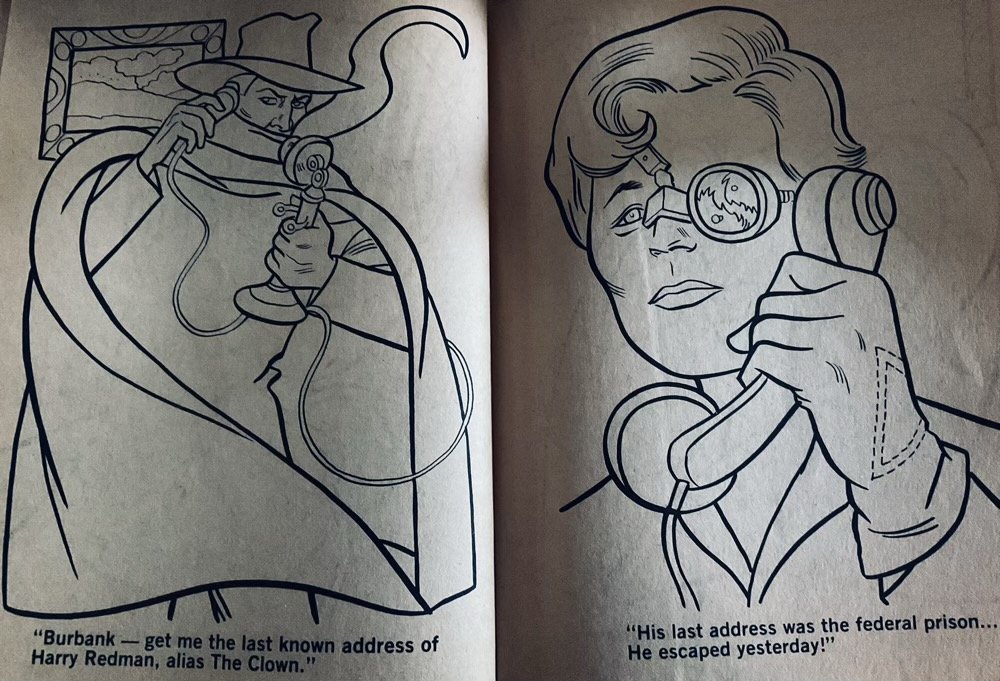
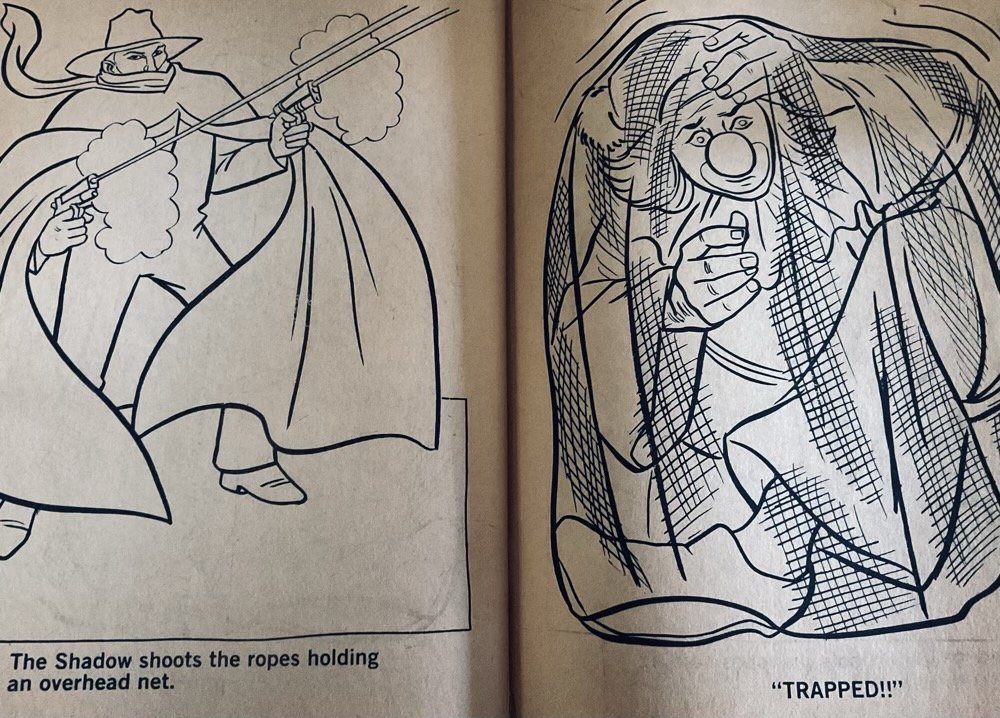
The Shadow Coloring Book (1974)

A few pages from Saalfield’s 1974 coloring book that’s part of my beloved “weird 1970s Shadow stuff” sub-collection:

Interior art is credited to Tony Tallarico (1933-2022) and, while I haven’t been able to verify it, my suspicion is that the signed “LoBianco” of the cover is illustrator Nick LoBianco, whose credits, according to the linked blurb, include ghost-illustrating 1960s Peanuts merch, illustrating many, many lunchboxes, and, perhaps most interestingly, designing The Monkees’ logo.

shut up linear brain

Pretty sure that my (one of my many) problem(s) over the last few writing weeks is that I've slipped back into a pattern of thinking too linearly. Seems to manifest itself most when working in fiction, so I probably should have spotted it before and recognized it as the problem, or at least part of it. Most likely some residual trepidation about fiction that I was long ago able to (more or less) abandon with non-fiction; like anything, it takes time and practice and the occasional renewing of vows.

Solution: return to "slips of paper" or the zettel/Obsidian way of parsing out individual notes from the notebook cacophony, tag them, and stuff in a project file (or the general digital brain catch-all if devoid of a certain project). Embrace the chaos, resist the urge to organize too soon; order and a whole comes later.

Tagging as Note to Self so I can reference if not the entirety of this piece then at least its title.